
No. You do not need insurance for a mobility scooter in the UK. GOV.UK is direct about it, and the rule covers both classes of scooter. Insurance is recommended, not required. What the law does ask for is a separate matter, and it changes with the class you ride. Here is the legal position, what mobility scooters insurance actually covers, and which rules put you at risk.
Does a Mobility Scooter Need Insurance by Law?
GOV.UK puts it in one sentence. “You do not need insurance for a class 2 or class 3 mobility scooter or powered wheelchair, although it’s recommended.” That wording sits on the GOV.UK page for tax, registration and insurance.
The DVLA says the same thing in its own leaflet on registering a mobility vehicle. Insurance appears in the list headed “You will not need,” followed by the words “although it’s recommended.” So the answer is the same for a 4mph pavement scooter and an 8mph road-legal one.
What the Law Does Require
Three things are not optional.
Who May Ride
The rules on who can drive one are narrow. You can only drive one if you have trouble walking. The cause must be an injury, a physical disability or a medical condition. Four other cases are allowed:
- Taking it for maintenance or repair
- Testing it as a manufacturer
- Demonstrating it before sale
- Training a disabled user
Ride without one of those reasons and have an accident, and the penalty can match driving a car. GOV.UK lists a prison sentence, a driving ban or an unlimited fine.
Eyesight
For Class 2 or Class 3, you should be able to read a car registration number from 12.3 metres. That is 40 feet. GOV.UK warns that you can be prosecuted if you have an accident because of poor eyesight.
Registration
Class 3 vehicles must be registered with the DVLA. Class 2 vehicles and manual wheelchairs need no registration and no vehicle tax. Where a vehicle is registered with the DVLA as a mobility scooter or powered wheelchair, no vehicle tax is payable.
Why is Mobility Scooters Insurance Still Recommended?
The DVLA leaflet says what cover is for. Suitable schemes cover your own personal safety and other people’s. They can also cover the value of the vehicle.
That second point is worth sitting with. A scooter is not a small purchase. Across the Adapt A Home range the four Equinox models run from £1,695 to £2,795, excluding VAT. If one is stolen or damaged, nothing in the law puts that right for you.
The Rules You Ride Under
These are the rules you ride under day to day. They come from the Highway Code, rules 36 to 46.
On pavements you must not travel faster than 4mph, and you should give pedestrians priority. Slow down where the pavement is narrow or crowded. Leaving the pavement, look round first, use dropped kerbs where you can, and take the kerb at right angles. Never attempt a kerb higher than the manufacturer recommends.
On the road, Class 3 vehicles travel with the traffic. Class 2 users should use the pavement where there is one. Lights must be used at night, and a reflective jacket or reflective strips make you easier to see.
One limit is absolute. These vehicles must not be used on motorways. Unrestricted dual carriageways with a limit above 50mph should be avoided. If one is used, a flashing amber beacon is mandatory. On all other dual carriageways a beacon should be used.
Normal parking restrictions apply, and Blue Badge concessions apply to a vehicle displaying a valid badge.
Which Class is Your Scooter?
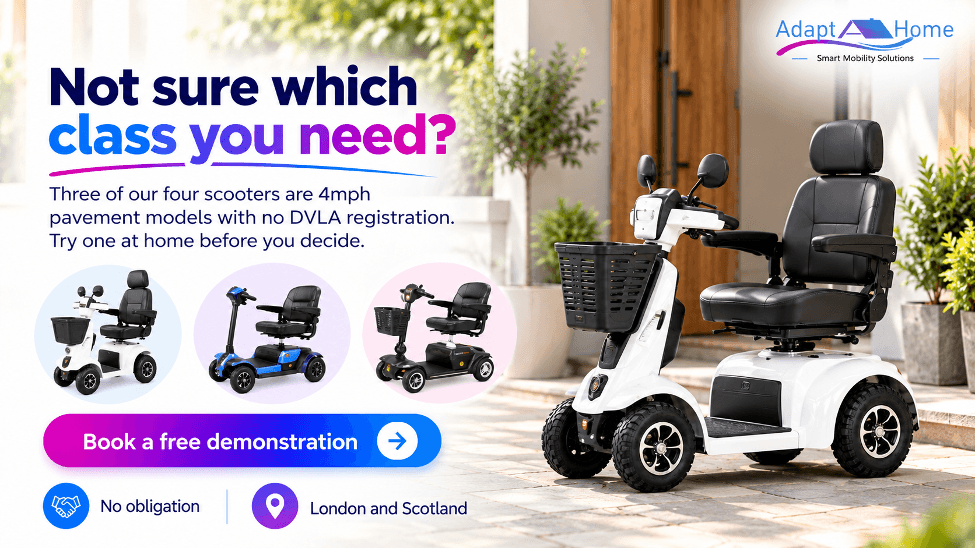
This is where the registration question is decided, so it is worth knowing before you buy. Three of the four scooters in the range have a 4mph top speed. One is Class 3.
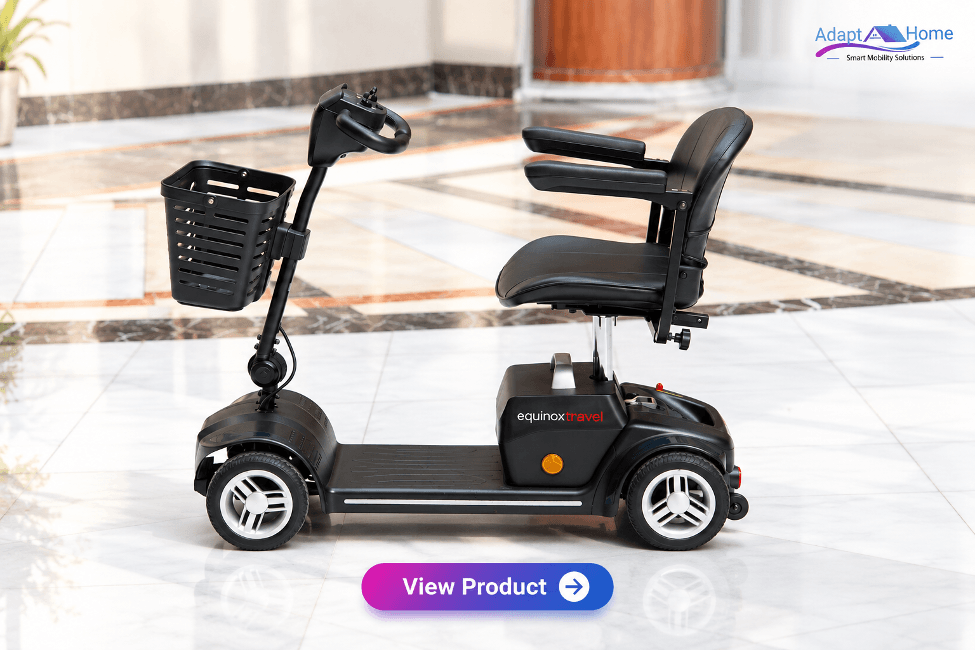
Equinox Travel
A rear wheel drive travel scooter with a 4mph top speed. Range is 9.3 miles, or 15km, under ideal conditions. Maximum user weight is 136kg, which is 21.4 stone. It runs on a 24V 12Ah battery weighing 9kg, has dual 270W motors, an electromagnetic brake and a swivel seat. It disassembles into five parts without tools: tiller, seat, body, rear section and battery.
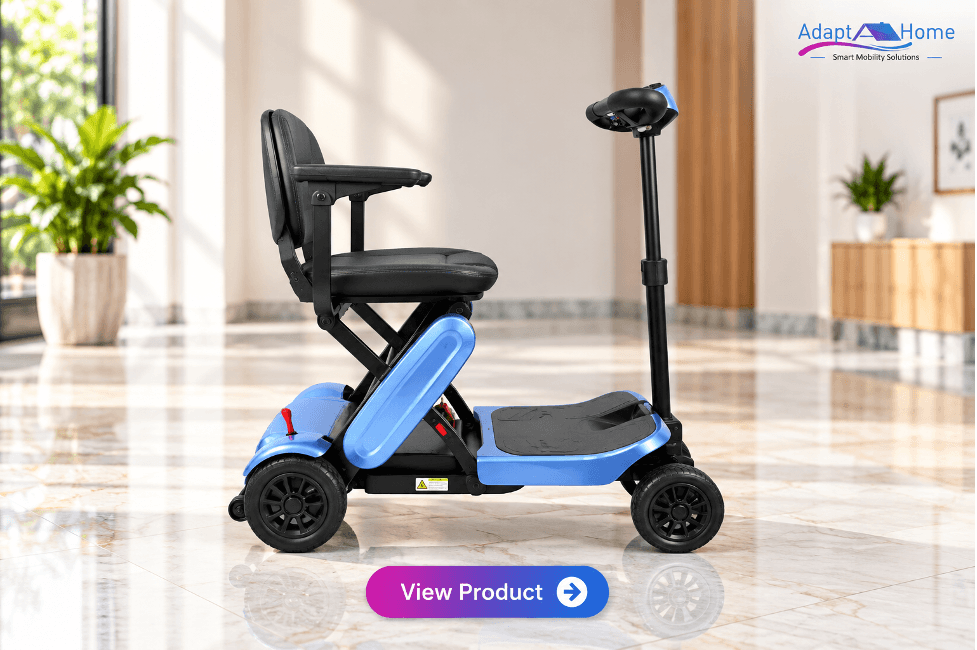
Equinox Smart Folding
One-touch folding, with a 4mph top speed and a range of 20km, or 12.4 miles. Maximum user weight is 125kg, which is 19.7 stone. Power comes from two removable 6Ah lithium packs at 24V output, described as flight-safe. It also has electromagnetic brakes and a power saving mode.
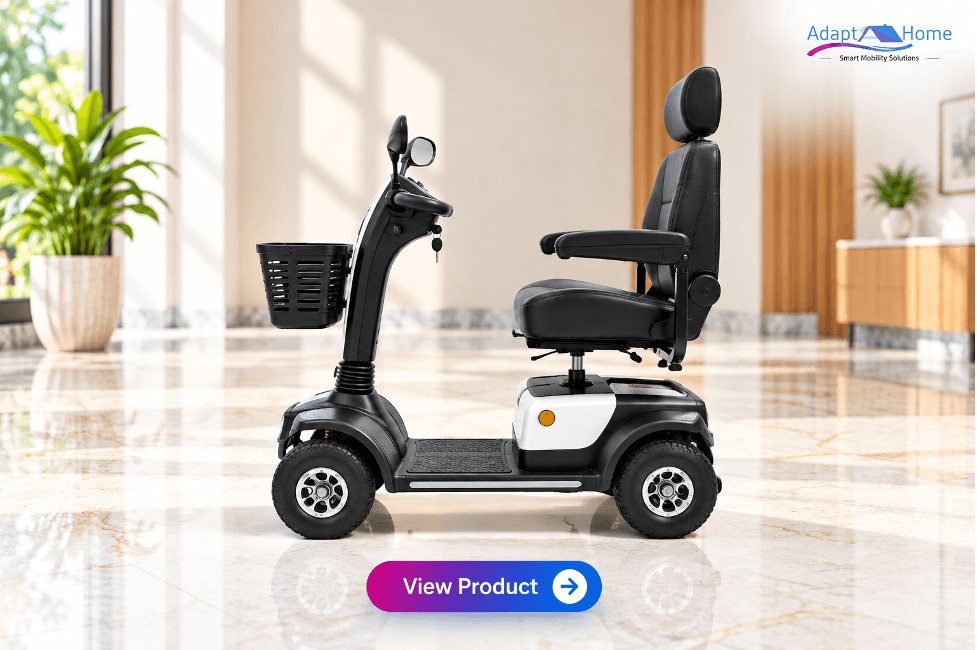
Equinox Nomad
A Class 2 pavement scooter, approved for pavements and pedestrian areas, crossing roads only at crossing points. Top speed is 4mph. Range is up to 38km, or 24 miles, on the standard 24V 38Ah battery. The enhanced 52Ah takes it to 50km, or 31 miles. Maximum user weight is 150kg, which is 23.6 stone. It has a steel frame, a luxury reclining pilot seat and an all-in-one control panel.
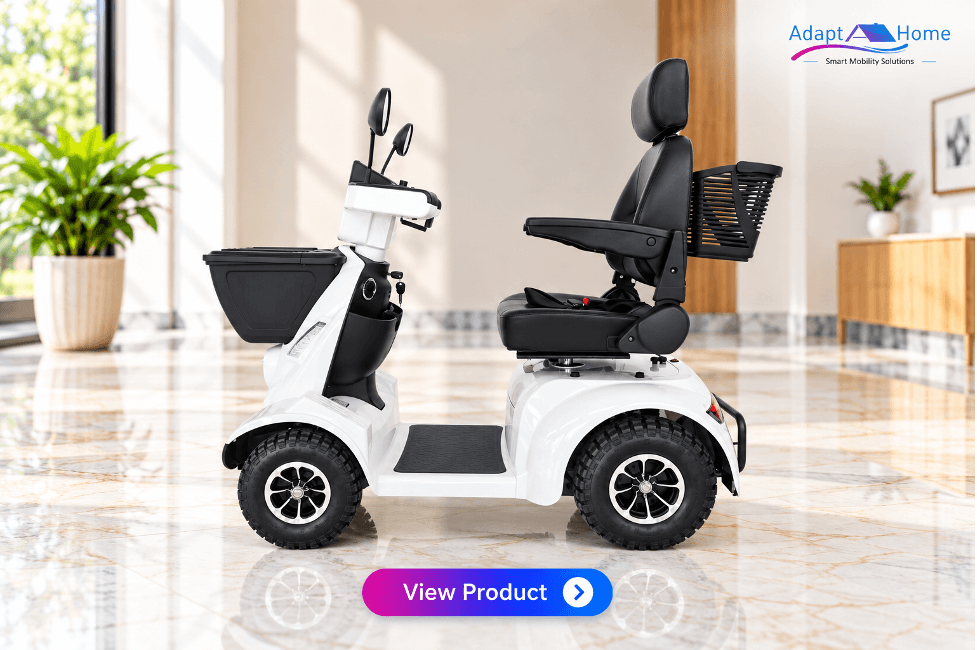
Equinox Grande All-Terrain
This is the Class 3 machine, and the only one in the range that must be registered with the DVLA. Top speed is 8mph. Range is 50km, or 31 miles, per charge on a 24V 75Ah battery. Real range varies with weight, terrain and speed. Maximum user weight is 210kg, which is 33 stone. It has an adjustable swivel pilot seat with lift-up armrests, front and rear automotive suspension, and a built-in Bluetooth speaker. Reduced from £3,000.
All four prices exclude VAT, and VAT relief is available to eligible customers. Specifications are on the mobility scooters page.
Registering a Class 3 Scooter
Only the Grande needs this. The form is the V55/MV, the application for first vehicle tax and registration of a mobility vehicle.
Send photocopies rather than originals, because originals are not returned. You need:
- For a new vehicle, a manufacturer’s certificate or declaration confirming it is new, with the frame or identity number
- For a used vehicle, evidence of the date of manufacture
- Proof of speed and unladen weight
Proof of speed and weight can be a supplier letter or printed email. A photocopy of a manual extract works, as does a printed extract from the supplier’s website. Without evidence of the manufacture date, the DVLA allocates a Q registration number.
There is no registration fee. Tax renews automatically each year, and no disabled exemption certificate is needed. Your V5C log book should arrive within four weeks. Tell the DVLA if you move, or if you sell or transfer the vehicle.
A road-going vehicle also needs certain equipment:
- A maximum speed of at least 8mph
- An efficient braking system
- A clear view of the road ahead
- An audible horn
- A rear view mirror
- Front and rear lights with reflectors
- Direction indicators that work as a hazard warning signal
Police can stop a vehicle without them.
Warranty is Not the Same Thing as Cover
Every Equinox scooter comes with a 12-month warranty, which can be extended, plus UK support and a charger. Repairs are arranged by phone or WhatsApp.
A warranty and an insurance policy are not the same thing. The warranty runs for 12 months and comes with UK aftercare and servicing support. The DVLA describes insurance as covering personal safety, yours and other people’s, plus the value of the machine. That second layer is your choice, and the law leaves it to you.
Try One Before You Decide
Adapt A Home offers free home demonstrations in London and Scotland with no obligation. Hire is also available across London and Greater London. That is one way to test a scooter in your own streets.
Call 020 8191 3247 or see the mobility scooters range.
Frequently Asked Questions
No. GOV.UK states that no insurance is needed for a Class 2 or Class 3 mobility scooter. It is recommended rather than required.
No. The rule is the same for both classes. A Class 3 scooter must be registered with the DVLA before road use. It also needs lights, indicators, a horn and a mirror.
No vehicle tax is payable where the vehicle is registered with the DVLA as a mobility scooter or powered wheelchair. Class 2 vehicles need neither registration nor tax.
No. The DVLA leaflet confirms that Class 3 mobility vehicles do not require a driving licence.
The DVLA says suitable schemes cover your own personal safety and other people’s. They can also cover the vehicle’s value. Terms vary by provider, so read any policy before buying.
Four miles an hour. The Highway Code says not to exceed 4mph on pavements or in pedestrian areas, and to give pedestrians priority.