
Can stairlifts be fitted to any stairs? Most staircases will take one. The shape of your flight decides which type, and there are three. Straight for a single run with no bend. Curved for bends, turns, intermediate landings and spirals. Narrow for tight or compact flights. Here is what each one needs, the measurements that decide it, and what a surveyor checks on the day.
Can Stairlifts be Fitted to Any Stairs?
For most staircases, yes. Two measurements set the limit, width and pitch. A straight rail needs 600mm of stair width. A curved rail needs 660mm. Most stairlifts handle a pitch of up to around 72 degrees.
Bends, landings and step count do not rule a staircase out. They decide which of the three types you need, which is what the rest of this guide covers.
Straight Stairlifts: One Flight, No Turns
If your stairs run bottom to top in one line with no bend, this is your category. Straight stairlifts use a fixed straight rail. They are the most affordable home option in the range.
The rail brackets sit on top of the treads and grip securely through the carpet. They can go on either side of the staircase. The survey recommends the side, based on things like the power socket and which arm and leg are stronger.
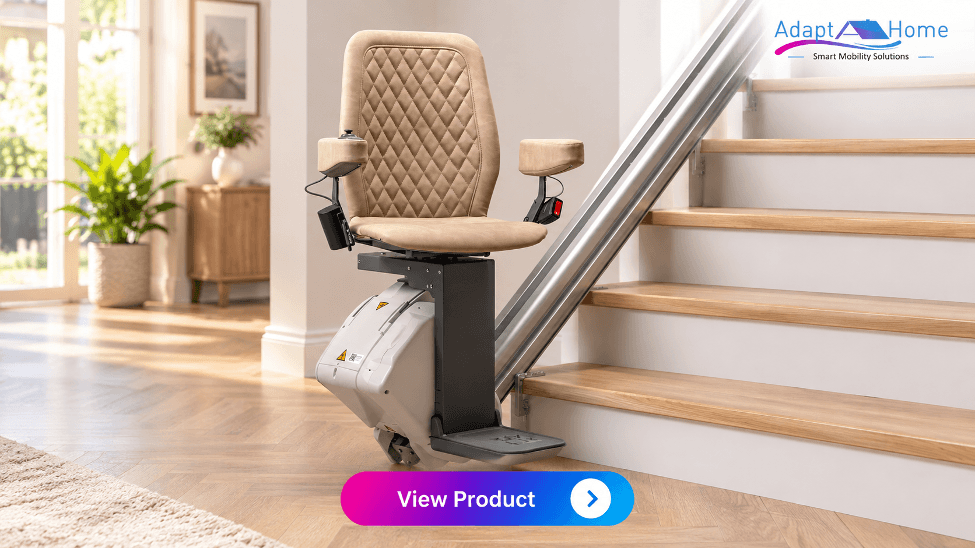
What comes as standard:
- Automatic swivel seat, so you step off facing away from the steps
- Seat, armrests and footplate that fold away
- Padded lap belt and footplate sensors
- Soft start and soft stop at each end of the journey
- Battery backup that keeps running through a power cut
- Quiet operation and user-friendly controls
Higher-spec options include powered swivel seats, slimline rails and ultra-quiet drive systems. Prices start from £1,495, which covers the stairlift and professional installation with no hidden fees. Fitting usually takes two to four hours. Short and long-term rental is available on straight models, which suits a recovery period or a trial before buying.
Curved Stairlifts: Corners, Half-Landings and Spirals
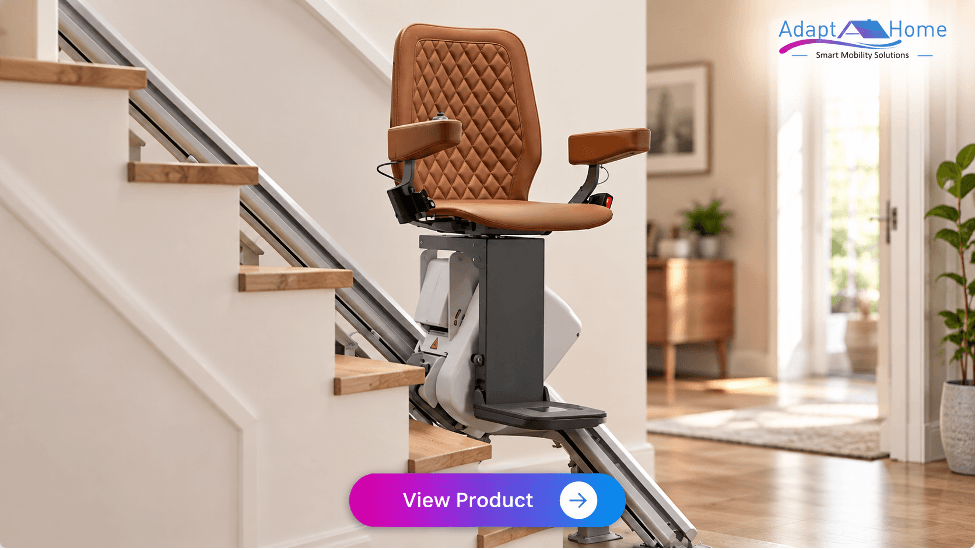
Curved stairlifts cover bends, turns, intermediate landings and spiral configurations. Half-landings and tight turns are included.
The model fitted is the ICON UP.Lift. Its rail is built from just two precision-engineered parts and assembled directly in your home. That matters for timing. The rail is prepared to your exact measurements in just days. Most installations are completed within days of the survey, and next-day fitting is available in most cases.
Installation usually takes three to four hours. A turn-and-go swivel seat helps on narrow staircases. Battery backup, folding seat, armrests and footrest all come as standard. The drive is quiet enough to call a hum.
On spiral and helical staircases the answer is yes in the majority of cases. A surveyor checks feasibility at the home survey. Indoor and outdoor options are both available. Curved prices are not published, so you get a tailored quotation after the free home survey.
Stairlifts for Narrow Stairs: From 600mm
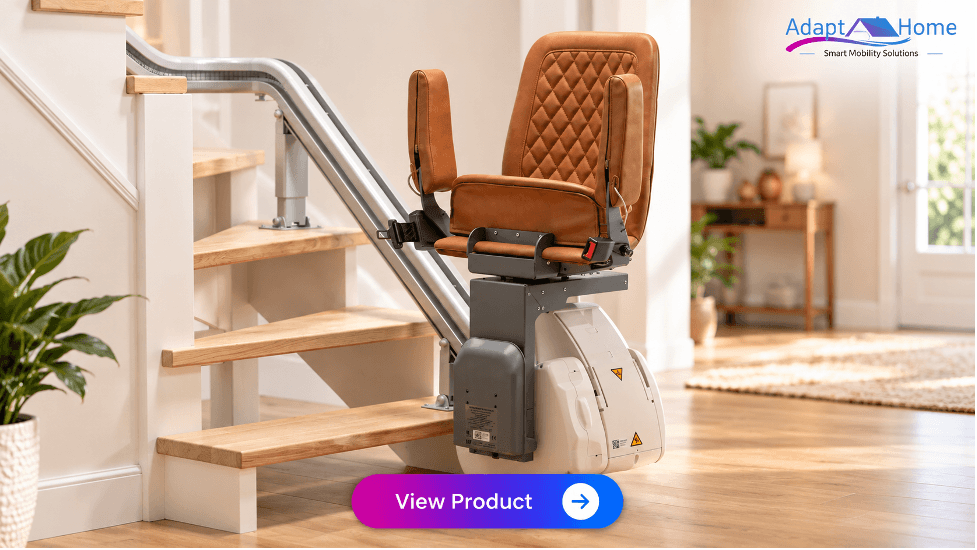
These are commonly fitted in Victorian, terraced and period homes. They also suit properties where a standard stairlift would block the passageway. Stairlifts for narrow stairs use an ultra-slim rail, slimmer than a standard stairlift rail.
Straight, narrow, curved and winding flights are all covered, including staircases with half-landings and tight turns. The straight model starts from around £2,200 and takes around two to three hours to fit. The curved version costs more because the rail is built on site, and takes more like three to four hours.
There are three seat choices for tight staircases.
Slimline seated. The most popular choice and the first recommendation for most customers. It suits most narrow straight and curved staircases.
Perching. You travel in a raised, angled position, which needs less width between the chair and the wall. It suits very tight straight staircases. It requires you to stand safely and maintain balance throughout the journey. If standing is getting harder, a seated model is the safer choice.
Rotating seat. For very narrow curved staircases, the seat pivots at the bends. That reduces the knee-to-wall clearance needed.
Noise is around the same level as a household microwave. The lift stops automatically if it detects an obstruction, and there is a seatbelt as standard.
The Rail Fixes to Your Stairs, Not Your Walls
The rail fixes to the stair treads, not the walls. No wall drilling and no structural work are involved. Wall strength never comes into the decision.
Removal leaves no structural damage and no holes in the plasterboard. Only minor marks on the treads remain, and those are usually hidden by carpet. The rail can also be reinstalled in a new property if you move.
Planning permission is not required to install a stairlift in most UK homes. Listed buildings are the exception, and listed building consent may be required before any works begin. Renters need written permission from their landlord. Housing association and council tenants may also be eligible for funding through the Disabled Facilities Grant.
Staircase Shapes that are Still Covered
These all have a solution in the range:
- A bend or a turn at either end
- An intermediate landing or half-landing partway up
- A spiral or helical flight
- A winding staircase with tight turns
- A steep climb, up to around 72 degrees
- An obstruction at the top or bottom of the flight
Adapt A Home says it regularly installs stairlifts in homes where other companies have said it cannot be done. If you have had a refusal, a second survey is worth having.
What the Surveyor Measures
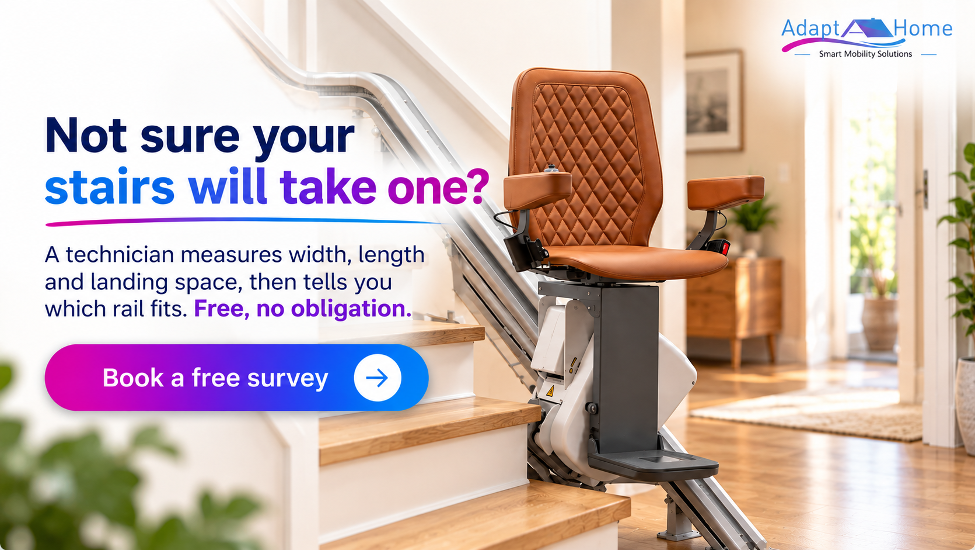
A qualified advisor and a technician visit before any quote is given. They measure:
- Stair width
- Length of the run and the number of steps
- Landing space at the top and bottom
They also check power access and flag anything that could affect the installation.
Obstructions matter too. Anything in the way at the top or bottom of the staircase affects the price. The surveyor assesses it on the day.
Weight is the other limit. Most models, including the ICON UP.Lift, safely support users up to 120kg or 19 stone. Heavy-duty models are available.
Floor covering is not an obstacle. Carpeted, wooden, tiled and laminate stairs all work. No carpet removal is required.
The Quote, VAT Relief and Grants
You get a written quotation after the survey. It is described as clear, fixed and final, with no unexpected costs on fitting day. It names the recommended model and breaks down installation and any customisations. The visit is free with no obligation to buy.
VAT relief is available if you are chronically sick or disabled. The declaration is completed at checkout or with the sales team. Without it, VAT is charged at the applicable rate.
A Disabled Facilities Grant may also contribute. In England the maximum is £30,000, in Wales £36,000 and in Northern Ireland £25,000. It is means-tested on household income and savings over £6,000, and administered by your council. Disabled children under 18 can get a grant without their parents’ income being taken into account. Figures are from GOV.UK.
PayItMonthly spreads the cost over a maximum of 12 monthly instalments, subject to eligibility and status checks. The page states PayItMonthly is not currently regulated by the Financial Conduct Authority.
Find out What your Staircase Needs
A survey is what confirms it. Book a free home survey and a technician measures the staircase, then quotes. No obligation either way.
Call 020 8191 3247 or request a survey.
Frequently Asked Questions
From 600mm for a straight rail and 660mm for a curved one. Below those widths, only a survey can confirm what is possible.
In the majority of cases, yes, using a curved rail. A surveyor checks feasibility during the free home survey.
The rail fixes to the treads, so no wall drilling or structural work is involved. Minor marks on the treads can remain, usually hidden by carpet.
A straight stairlift usually takes two to four hours. A curved one usually takes three to four hours. Both are normally finished in a single visit.
Not in most UK homes. Listed buildings are the exception, and consent may be required. Renters need written landlord permission.