
If you’re reading this, chances are you’re not just idly curious. Something has changed in your body, in your parent’s body, in the way a normal Tuesday now costs more energy than it used to. You’re here because you’re trying to make a decision or help someone else make one, and you want to get it right.
Let’s cover what a mobility scooter actually is, who uses them, the emotional side of accepting one, how to choose the right type, and what to ask before you buy it. Whether you’re considering one for yourself or helping a family member decide, everything here is practical, honest, and written for real people.
What a Mobility Scooter Actually Is
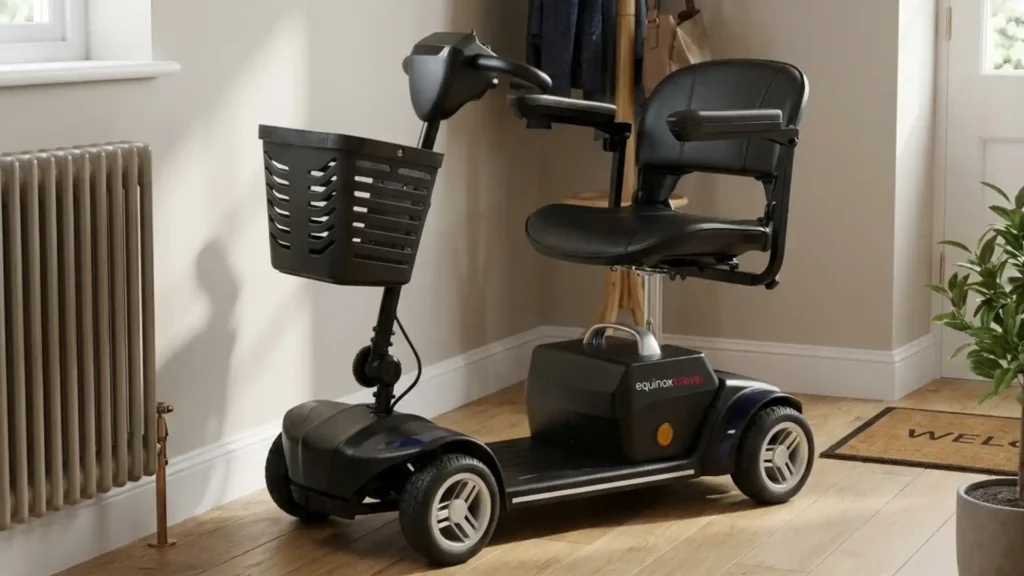
A mobility scooter is a battery-powered personal mobility device designed to carry a seated user across flat or moderately uneven surfaces without requiring manual effort. In practice: a padded seat above a flat foot deck, a vertical tiller steered with both hands, a motor in the rear or centre chassis, and three or four wheels.
You steer by rotating the handlebars left or right. Speed is controlled by a thumb lever or finger trigger on the tiller; release it, and the scooter stops. That is the entire control mechanism for most users.
Battery and range: Motors draw power from either sealed lead-acid or lithium-ion batteries. Lithium-ion is now standard in travel-class scooters because of its weight saving. Lead-acid remains common in full-size outdoor models where cost and cycle longevity matter more. Real-world range varies from around 8 miles on a compact travel scooter to 25+ miles on a full-size outdoor model. Always verify against the specific model’s specification sheet, as terrain, user weight, and battery age all affect actual range.
Travel Scooters vs Full-Size Scooters
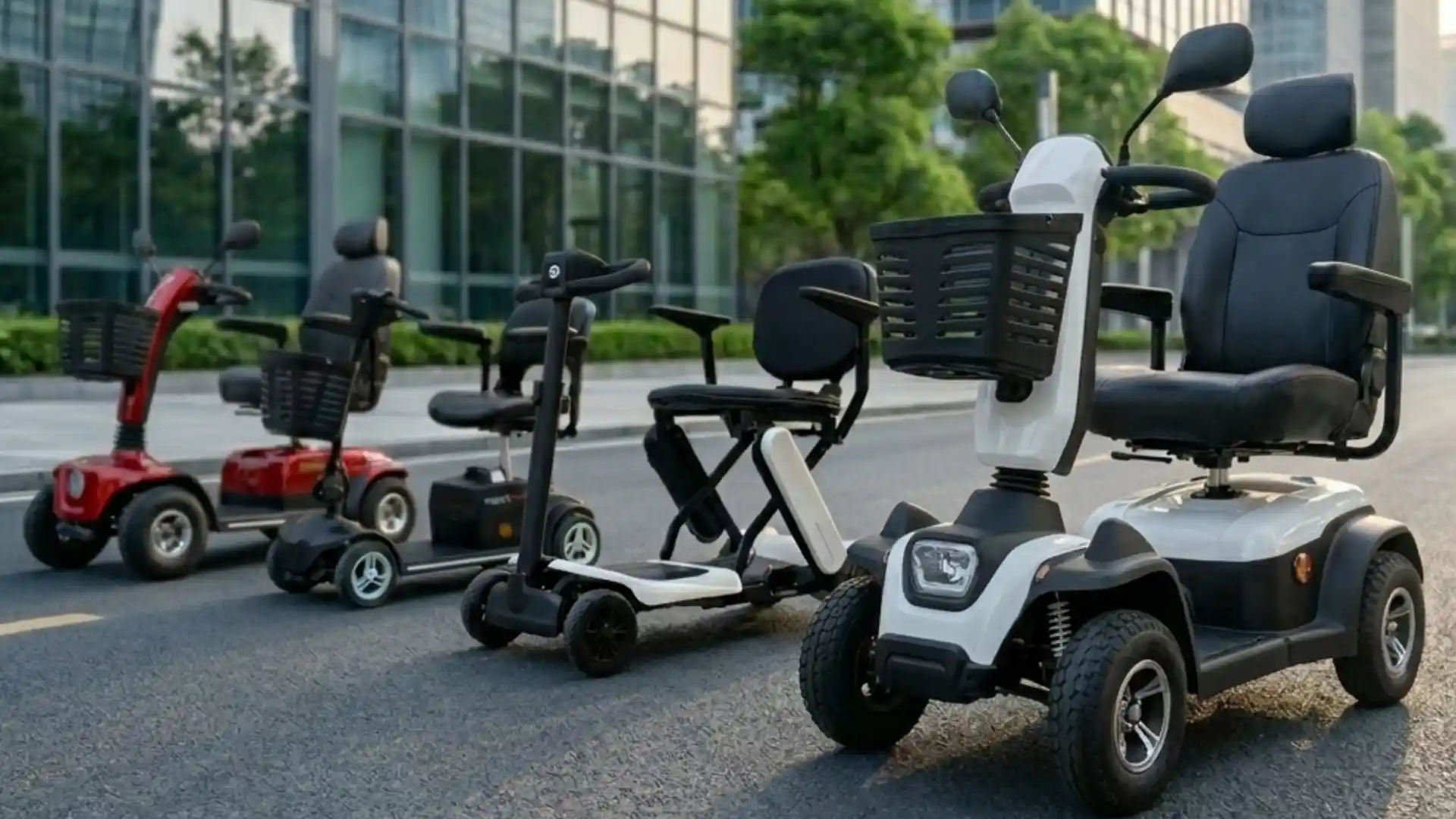
Travel or portable scooters disassemble into four or five pieces, the heaviest part typically 14–18 kg, which one person can lift into a car boot. They are narrower and shorter, which makes them manageable in restaurants, GP surgeries, and homes with standard doorways. The trade-off is real: lower ground clearance, reduced weight capacity, shorter range, and less stability on uneven surfaces.
Full-size scooters are built for outdoor range, durability, higher weight capacities, and rougher terrain. They do not disassemble for car transport; they need a vehicle ramp or boot hoist. They are the right device for someone whose main limitation is outdoor distance, not indoor navigation. That distinction between a supplemental aid and a primary one is one of the first questions worth answering before you look at a single product.
How a Mobility Scooter Differs from a Power Wheelchair
Many people treat these as interchangeable. They are not.
A mobility scooter requires reasonable upper body control, sufficient grip strength to operate the tiller, and the ability to step on and off with minimal assistance. The seating position is upright, similar to sitting in a dining chair.
A power wheelchair is controlled by a joystick and is designed for users who cannot safely manage tiller steering, have significant upper limb weakness, or need a more supportive seating system for posture and pressure care. Power wheelchairs also have a tighter turning circle, making them more manoeuvrable indoors. If the person considering a scooter has significant hand tremor, reduced grip strength, or difficulty stepping onto a platform, a power wheelchair is likely the more appropriate choice. An occupational therapist assessment can clarify this quickly, and our team at Adapt A Home can also help guide that conversation. How to choosing the right mobility aid
Who Uses a Mobility Scooter and Why the Answer Is Broader Than You Think
The most familiar users are older adults with arthritis, heart conditions, or COPD, people for whom walking any meaningful distance has become genuinely exhausting or painful. But that is not the whole picture.
Arthritis and joint pain the most common reason people first enquire. Hip, knee, and lumbar arthritis make sustained walking painful. A scooter removes the pain from the equation without requiring the user to stop going out.
COPD and cardiac conditions, breathlessness on exertion is a major, underappreciated driver of scooter use. For someone with moderate COPD, walking 200 metres may be genuinely prohibitive. A scooter makes the difference between attending an appointment independently and needing an escort.
MS and fatigue-related conditions: fatigue in MS is not tiredness. It is a neurological symptom that can be triggered or worsened by physical exertion. Many people with MS are ambulatory over short distances but use a scooter to conserve energy for activities that matter more than the act of walking itself. Energy conservation is a legitimate clinical goal, not a sign of giving up.
Parkinson’s disease scooter use with Parkinson’s requires careful assessment. Freezing episodes, tremor, and reduced reaction time can affect safe operation. It is not automatically contraindicated, but it should involve input from a neurologist or occupational therapist. How stairlifts help people with Parkinson’s disease (and how mobility aids more broadly support daily life with Parkinson’s)
Post-surgical recovery hip replacements, knee replacements, and cardiac surgery all involve periods where sustained walking is either prohibited or too demanding. A scooter bridges that period and meaningfully reduces recovery stress.
Post-stroke fatigue depending on the extent of stroke-related impairment, grip strength, upper body control, and cognitive function all factor into suitability. An occupational therapist assessment is the right starting point.
Early-stage dementia suitability depends entirely on the individual’s cognitive assessment. It is not a blanket yes or no. Anyone considering a scooter for a person with early-stage dementia should involve their GP and an occupational therapist before purchase.
Guide for Caregivers
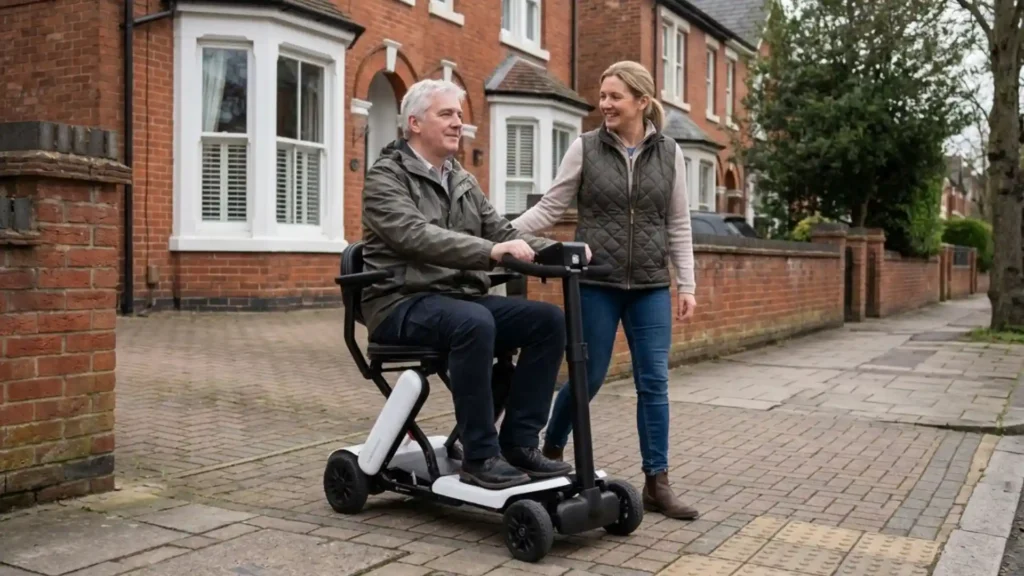
If you are researching this on someone else’s behalf – a parent, a partner, a patient – this section is for you directly.
You are probably carrying two concerns simultaneously. The first is practical: will this actually work for them given their condition and living situation? The second is relational: how do I bring this up without it turning into a confrontation about what they can no longer do?
Both are legitimate. On the practical side, the right question is not “Does their diagnosis allow a scooter?” It is “What does their daily life actually require, and what does safe operation require?” An occupational therapist can answer both in a single home assessment. Occupational therapist assessments On the relational side: the resistance you may be encountering is almost never about the scooter itself. It is about what accepting the scooter feels like. That is addressed directly in the next section. Mobility problems with elderly relatives
The Part Nobody Talks About: Accepting a Mobility Scooter
For many people, the moment they seriously consider a mobility scooter brings up feelings that have nothing to do with the device. Grief. Embarrassment. Fear of how others will see them. A sense that accepting a scooter means accepting a version of themselves they are not ready to be.
These feelings are normal. They are also extremely common.
What is worth saying plainly is this: a mobility scooter does not take away independence. For the vast majority of users, it restores independence that had already been quietly eroding. The person stopped going to the farmers’ market because the walk from the car park had become too much. The grandfather who stopped attending school events because he could not manage the distance from the gate to the field. The woman who had been relying on her adult daughter for every trip outside the house for eight months before anyone suggested there was another option.
When people who use scooters describe the experience, the word that comes up most often is not “convenient”. It is “free”.
The grief is real. The loss that preceded the scooter is real. But there is a difference between grieving what has changed and refusing the thing that would make the present liveable. Most users report their only regret is waiting as long as they did. If you are a carer navigating this conversation: lead with what they would be able to do, not with what they currently cannot. The question is not “Do you need help?” It is “Where would you go first?” Caring for an elderly parent: a practical guide
Types of Mobility Scooters and Where They Work
Understanding the main categories prevents expensive mismatches between device and lifestyle.
Class 2 Pavement Scooters (Max 4 mph)
Legal on pavements only. No road use permitted, no DVLA registration required. The right choice for local trips: shops, GP surgery, visiting neighbours. Compact enough for most indoor environments. The most common entry-level choice for everyday use.
Class 3 Road Legal Scooters (Max 8 mph)
Can be used on roads as well as pavements. Must be registered with the DVLA; free to do, no licence required. Lights and indicators are fitted as standard. Built for longer distances, outdoor terrain, and users who need greater range and capability. Guide to UK mobility scooter laws
Travel or Portable Scooters
Disassemble for car boot transport. Lightweight enough for one person to manage. The right choice for users whose primary need is flexibility: holidays, hospital visits, family outings. Compact vs heavy-duty scooters compared
Heavy-Duty Outdoor Scooters
Higher weight capacity, greater ground clearance and longer battery range. Built for users who need a scooter as a primary rather than supplemental mobility aid, or whose terrain regularly includes uneven ground, grass, or slopes.
Browse all mobility scooters at Adapt A Home
Will It Work in Your Home?
This is the question most people skip and then regret.
Key measurements to check before you order:
- Doorway width: Most standard UK internal doors are 76cm wide. A compact travel scooter typically needs 60–65cm clearance. Full-size scooters may need 75cm or more. Measure every doorway on the intended route through the property
- Turning space: A scooter needs room to turn around. Tight hallways and small rooms limit which models are viable measure the space between furniture and walls in areas the scooter will be used most
- Storage and charging: The scooter needs somewhere dry and accessible to charge overnight. A hallway, porch, or garage with a nearby plug socket works well. The charger cable should never cross a walking route
- Access from outside: Steps at the front door, a narrow garden path, or a steep driveway can all create problems not immediately obvious until the device arrives. A portable ramp solves most step issues
Are portable wheelchair ramps safe?
Funding, VAT Relief, and the Motability Scheme in the UK
NHS and Social Care
Mobility scooters are not routinely provided by the NHS. Some local authorities offer loans or grants through occupational therapy referrals, but availability varies by area. An OT assessment is the recommended starting point for anyone who may qualify for funded provision. Our funding and assessments guide
VAT Relief
If you have a disability or long-term health condition, you are entitled to purchase a mobility scooter free of VAT under HMRC’s relief scheme for disabled people. At Adapt A Home, VAT is removed automatically at checkout when you confirm eligibility a straightforward 20% saving on the purchase price. Full VAT exemption guide
Motability Scheme
If you receive the Enhanced Rate Mobility Component of Personal Independence Payment (PIP) or the Higher Rate Mobility Component of Disability Living Allowance (DLA), you may be eligible to use those payments toward a scooter through the Motability Scheme.
Interest-Free Finance
At Adapt A Home, we offer interest-free monthly payments for customers who prefer to spread the cost. Our team can walk you through options before you commit to anything.
What to Ask Before You Buy
These questions prevent buyer’s remorse:
- What is the heaviest single piece when disassembled? If you are buying a travel scooter, you need to know whether you or a family member can realistically lift it
- What is the actual battery range under real conditions not the manufacturer maximum? Ask specifically about range on mixed surfaces at the user’s weight
- What is the turning circle? Test this against your narrowest internal doorway and hallway
- What is the seat height, and can it be adjusted? Getting on and off safely is not guaranteed for every user
- What does the warranty cover, and who handles servicing? A scooter that breaks down without nearby service support is a serious problem
- Can I try it at home before committing? At Adapt A Home, the answer is yes we offer free home demonstrations with no obligation
Planning a trip abroad with your mobility equipment
What Happens After It Arrives
Most users report an adjustment period of one to two weeks. The first few outings feel unfamiliar, judging width in doorways, managing kerb cuts, and understanding how the scooter handles slight inclines. This passes quickly.
Practical notes for new users:
- Charge the battery every night, even after short trips, partial discharge followed by full recharge extends battery life
- Check tyre pressure monthly on pneumatic-tyre models. Under-inflated tyres reduce range and stability
- Service the scooter annually. Adapt A Home provides ongoing service and maintenance support for every scooter we sell
- Tell your car insurer if you are transporting the scooter in a vehicle regularly, most policies cover it, but worth confirming
- Register a Class 3 scooter with the DVLA before using it on any road. Registration is free and straightforward
Read: Safety first, preventing falls at home with mobility aids
Read: Choosing the right mobility aid: A comprehensive guide
Read More Blogs
- Mobility Scooter Laws UK: Class 2 and Class 3 Rules Explained
- Compact vs Heavy-Duty Mobility Scooters: What’s the Difference?
- Planning a Trip Abroad with Your Mobility Equipment
- VAT Exemption on Mobility Equipment
- Funding and Assessments for Mobility Equipment
- Are Portable Wheelchair Ramps Safe?
- How to Make Your Home Wheelchair Friendly
- Caring for an Elderly Parent